Duplicate Data Entry: The Most Expensive Problem That Never Appears on an Invoice
By Maria-Luisa Bondarenko ·
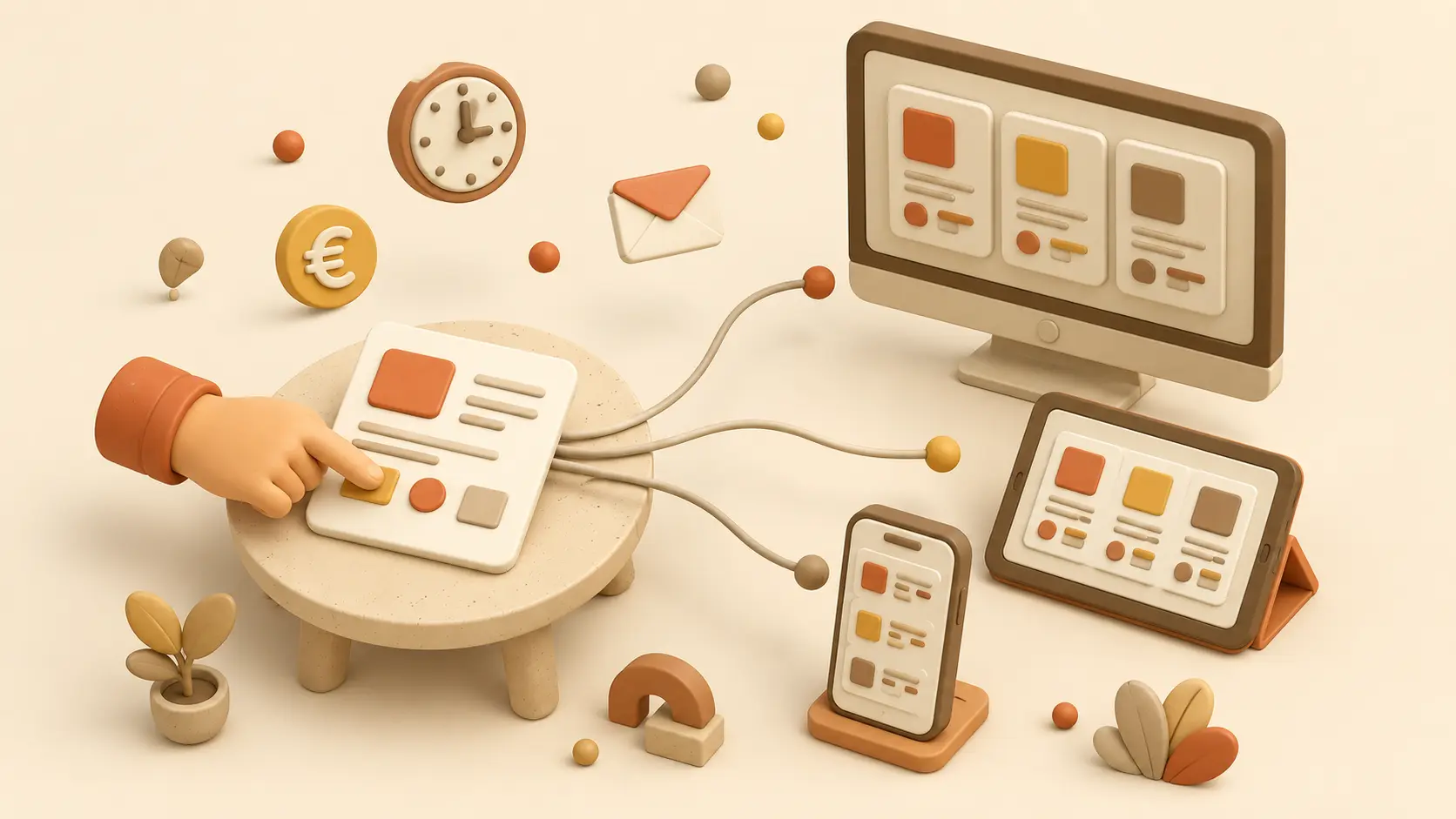
An order comes in by email. Someone types it into the order book. Then into the invoicing software. Then into the Excel list for reporting. The same data, entered three or four times, every day, by people who really have better things to do. Almost every business that has grown over time knows this, and almost everywhere it's treated as a law of nature. But it isn't. It's a solvable problem, and this article is about what it really costs, why it arises and which three ways there are to get rid of it, with an honest assessment of which way fits when.
What double entry really costs
The pure typing is the smallest item. Do the maths anyway: if three staff spend 30 minutes each per day on multiple entry, that's over 350 working hours a year. That's almost a quarter of a full-time position, just for retyping data that already exists.
The bigger item is invisible: errors. Every manual transfer is an opportunity for transposed digits, forgotten items and outdated states. A single transfer error in an invoice or an order costs more time to resolve than a week of retyping takes, and it costs something that can't be measured in hours: the trust of the customer who receives the wrong delivery.
And the third item: your data is never up to date in one place. Which figure is correct, the one in the order book or the one in the Excel list? Anyone running analyses on data sets that are synchronised by hand is analysing the past, not the current state.
Why the problem arises
Nobody plans double entry. It grows. Over the years, a business acquires the most obvious tool for each task: an accounting package, an industry-specific program, a few Excel lists for everything in between. Each tool is sensible on its own. They just don't talk to each other, and the bridge between them is then built by people, by hand, every day. That also explains why the problem is so persistent: there's no moment in which it arises, and therefore no moment in which anyone raises the alarm. It simply gets a little bigger every year.
The three ways to get rid of it
Way 1: use built-in features. Many programs can do more than is known in the business. Import and export functions, ready-made connections to common accounting software, automatic imports. Before anyone builds or buys something new, half a day is worth spending on the question: what can our existing systems already do that we're not using? That's the cheapest way, and it's the one most often skipped.
Way 2: connect systems. When the built-in features aren't enough, the next stage is an interface: a small technical bridge that carries data automatically from one system into another. The order is entered once and appears everywhere it's needed. That's usually a manageable project of weeks, not months, and it keeps all existing systems alive. The prerequisite: the programs involved must be technically accessible, which is almost always the case with modern software and occasionally not with very old software.
Way 3: consolidate. Sometimes the honest diagnosis is that it's not the connections that are missing, but that too many separate solutions exist side by side. Then the sustainable answer is one system that maps the central workflows under one roof, whether a suitable standard solution or a custom-built one. That's the most involved way, and it only pays off once ways 1 and 2 have been checked. Anyone who goes this route should do it step by step: one workflow after another, the old stays on until the new has proven itself.
Where you can start tomorrow
For the first step you need neither budget nor a provider. Take the one process that occurs most often, in most businesses it's the path of an order from enquiry to invoice. Write down which systems and lists the same details get entered into, and by whom. That one sketch shows you in black and white where your most expensive double entry sits, and therefore also where the first connection pays for itself fastest.
Wandelwerk Tech connects systems and builds custom software for mid-sized businesses. If you want to know which of the three ways fits your business, talk to us, the assessment is without obligation.